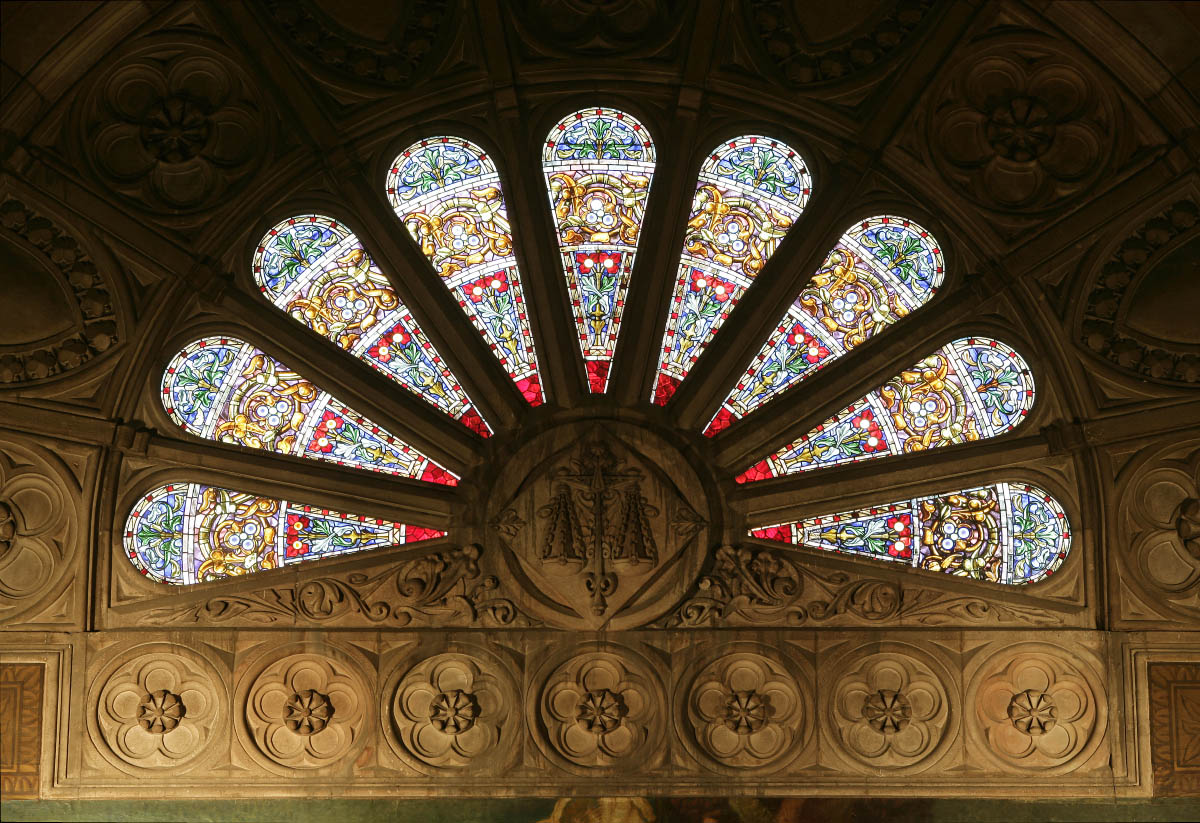


Pompeia Church
Standing in one of the city’s most bustling streets, the “Pompeia” church (dedicated to Our Lady of the Rosary of Pompeii) still helps to preserve the air of grandeur that typified this area at the time it was built. Because of its prime site it is one of Sagnier’s best-known works. As in the case of other religious works by the architect, the complex—consisting of the church and the adjacent convent for Franciscan friars (Capuchins)—employs a freely-interpreted neo-Gothic vocabulary: the church, with its three aisles separated by slender columns, harks back to aspects of Catalan Gothic tradition, such as the central aisle with arches roofed by wooden beams (a solution similar to that in the chapel of Santa Àgueda, in the old palace of the counts of Barcelona), while Sagnier’s inventiveness makes itself felt in features like the capitals with their stylised floral decoration and the triangular openings. The facade giving onto the street is of stone and is notable for the carvings by Josep Llimona: a relief in the doorway and an image of saint Francis of Assisi on the upper gable.
The convent (finished in 1915) is somewhat more sober, in the Franciscan tradition of humility, and combines stone with brick. It consists of three wings, parallel with the alignment of the outer facades; with the church, these form an irregular courtyard which is ornamented with mosaics. One of the most important rooms in the convent is the library, which occupies three floors (the upper ones being protected by metal railings) and is illuminated from above by a skylight.
In 1936, the interior of the church was destroyed and the retable of the high altar was lost, with its paintings by Joan Llimona and central image of Our Lady of Pompeii by his brother Josep (both, like Sagnier, co-founders of the Cercle Artístic de Sant Lluc). After the Civil War a restoration by the architect Pere Benavent restored the interior to its original appearance, although the opportunity was taken to create a crypt below the central aisle.
-
date
1907-1910
-
location
Barcelona
-
address
Av. Diagonal, 450 / Riera de Sant Miquel


